
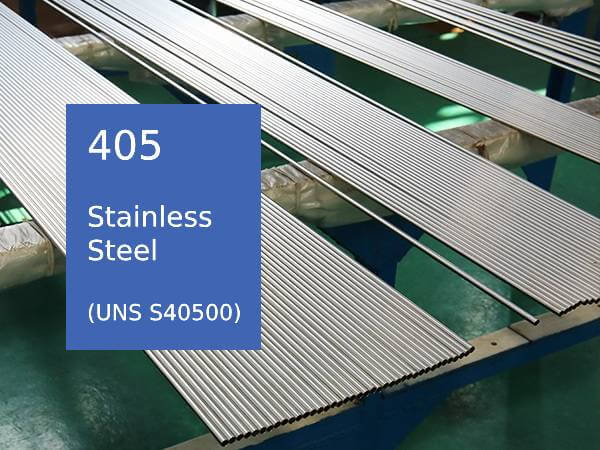
405 stainless steel is a ferritic stainless steel with low chromium and high aluminum content, It is known for its excellent corrosion resistance and moderate strength. This alloy consists primarily of chromium, with small amounts of nickel, silicon, and manganese added, its chemical composition enables it to withstand a variety of corrosive environments, including mild atmospheric conditions and slightly corrosive chemical environments. Due to its relatively low chromium content, 405 stainless steel exhibits slightly lower corrosion resistance compared to other stainless steel grades; however, this is offset by its excellent weldability and formability. Consequently, it is suitable for components requiring resistance to atmospheric corrosion, such as automotive trim, kitchen appliances, and architectural finishes. 405 stainless steel is easy to fabricate and cost-effective, making it a suitable choice for applications where moderate corrosion resistance and adequate strength are essential.
Chemical Composition
- Chromium: 11.5% – 14.5%
- Nickel: 0.60%
- Manganese: 1.0%
- Silicon: 1.0%
- Aluminum: 0.10-0.30%
- Carbon: 0.080%
- Phosphorous: 0.040%
- Sulfur: 0.030%
Mechanical Properties
- Tensile Strength, min 415 Mpa
- Yield Strength, min 170 Mpa
- Elongation, min 20%
- Hardness, max Rockwell 88 HRBW
Physical Properties
- Density: Approximately 7.75 g/cm³.
- Melting point: 1480–1530°C.
- Magnetic properties: Magnetic, suitable for applications requiring magnetic properties, such as electrical grounding terminals.
- Thermal conductivity: 24.2 W/(m·K) (in the range of 100–500°C).
- Coefficient of linear expansion: 10.8×10⁻⁶/K (in the range of 100–500°C).
- Specific heat capacity: approximately 502 J/(kg·K).
Equivalent
- UNS S40500
- GB 06Cr13Al
- JIS SUS 405
- EN 1.4002
- BS 405S17
Key Characteristics
- Good corrosion resistance: It exhibits good corrosion resistance in mild atmospheres, water vapor, and many weakly corrosive media; it outperforms carbon steel but is generally less resistant than austenitic stainless steels such as 304.
- Resistance to chloride stress corrosion cracking: Compared to austenitic stainless steel, ferritic stainless steel offers greater resistance to chloride-induced stress corrosion cracking, which is a significant advantage.
- High thermal conductivity: Its thermal conductivity is better than that of austenitic stainless steel, making it suitable for heat exchange applications.
- Low thermal expansion coefficient: Its thermal expansion coefficient is close to that of carbon steel, reducing the risk of stress caused by differing thermal expansion and contraction when joined or combined with carbon steel components.
- Non-magnetic: As a ferritic stainless steel, it is non-magnetic.
- Moderate mechanical properties: Its strength and hardness are higher than those of austenitic stainless steel, but its ductility and toughness are relatively lower.
Limitations of Grade 405
- Limited corrosion resistance: It has poor resistance to strong acids (such as hydrochloric acid and sulfuric acid), strong alkalis, and reducing media, and is not suitable for harsh chemical corrosion environments.
- Low-Temperature Brittleness: Ferritic stainless steel has a ductile-to-brittle transition temperature. When the operating temperature falls below a certain threshold (such as below room temperature), its impact toughness decreases significantly and it becomes brittle; therefore, it is not suitable for low-temperature environments.
- Insufficient High-Temperature Strength: Although it can withstand a certain degree of high-temperature oxidation, its high-temperature strength (creep strength) is low. Careful evaluation is required for long-term use in pressure-bearing components operating at temperatures above 500 degrees Celsius.
- Sensitivity to intergranular corrosion: Prolonged exposure to temperatures between 450 and 850 degrees Celsius may cause carbides to precipitate along grain boundaries, increasing susceptibility to intergranular corrosion. This is also one of the reasons why rapid cooling is required after welding and heat treatment.
Annealing
Grade 405 stainless steel is soaked at 649-760°C (1200-1400°F) and then cooled in air.
Welding
Stainless steel grade 405 has good weldability. The addition of aluminum suppresses the transformation of austenite to martensite during high-temperature cooling, significantly reducing the risk of hardening in the weld zone and eliminating the need for post-weld heat treatment. There is no risk of hardening in the heat-affected zone. Compatible welding methods include TIG welding and laser welding.
Forging
Grade 405 stainless steel is soaked at 817-871°C (1500-1600°F) and the temperature is then increased to 1038-1121°C (1900-2050°F). Forging below 816°C (1500°F) is not recommended for this stainless steel grade. Forging is followed by air cooling and finally annealing.
Forming
Usage of forming techniques enable grade 405 stainless steel to be easily spun, drawn and formed.
Machinability
Stainless steel grade 405 has excellent cold formability, with an elongation of ≥20%. It is suitable for processes such as deep drawing and cold bending, and can be formed through cold rolling and drawing.
Hardening
Grade 405 stainless steel can be hardened by soaking at 982-1010°C (1800-1850°F) and then oil quenched.
405 Stainless Steel Specifications
- ASTM A240 Standard Specification for Chromium and Chromium-Nickel Stainless Steel Plate, Sheet, and Strip for Pressure Vessels and for General Applications
- ASTM A276 Standard Specification for Stainless Steel Bars and Shapes
- ASTM A268 – Seamless and Welded Ferritic and Martensitic Stainless Steel Tubing for General Service
- ASTM A473 – Stainless Steel Forgings
- ASTM A479 – Standard Specification for Stainless Steel Bars and Shapes for Use in Boilers and Other Pressure Vessels
- ASTM A580 – Stainless Steel Wire
- ASTM A959 – Specifying Harmonized Standard Grade Compositions for Wrought Stainless Steels
- SAE J405 – Chemical Compositions of SAE Wrought Stainless Steels
Forms
- Bar
- Shape
- Coil
- Pipe
- Sheet
- Strip
- Tubing
- Wire
Applications
Stainless steel 405 is a stainless steel alloy with excellent corrosion resistance and is commonly used in the following applications:
- Petroleum and Chemical Industries: Stainless steel 405 is widely used in petroleum, chemical, and refining equipment, particularly in high-temperature, high-pressure environments. It offers oxidation resistance and high-temperature resistance, making it suitable for the manufacture of equipment such as pipelines, storage tanks, heat exchangers, and reactors.
- High-Temperature Furnace Components: Due to its excellent high-temperature resistance and oxidation resistance, 405 stainless steel is commonly used in the manufacture of high-temperature furnace components, such as furnace chambers, heating elements, and refractory supports.
- Automotive Exhaust Systems: 405 stainless steel exhibits good resistance to high temperatures and corrosive environments, making it widely used in automotive exhaust systems for components such as exhaust pipes, mufflers, and exhaust manifolds.
- Welding and Manufacturing Industries: Due to its mechanical properties and corrosion resistance, 405 stainless steel is also widely used in the welding and manufacturing industries. It can be used to manufacture structural components, vessels, marine parts, food processing equipment, and more.
- Chemical Processing Equipment: 405 stainless steel exhibits good resistance to certain chemicals and corrosive media, so it is commonly used in the manufacture of chemical processing equipment, storage tanks, piping, and valves.
Compared to 304 (austenitic stainless steel)
304 generally offers better corrosion resistance, ductility, and weldability than 405, and because it is non-magnetic, it has a wider range of applications. However, 405 has better resistance to chloride stress corrosion cracking and thermal conductivity, and is typically less expensive.
Comparison with 430 (ferritic stainless steel)
430 has a slightly higher chromium content (16%–18%) and generally offers slightly better corrosion resistance than 405, but its weldability is inferior to that of 405, and it is more prone to embrittlement after welding. 405 can be regarded as a variant of 430 with improved weldability.