
Duplex stainless steels are Fe-Ni-Cr alloys consisting of ferritic-austenitic microstructure at room temperature. These steels generally possess beneficial combinations of the austenitic and ferritic phases. Duplex stainless steels exhibit greater toughness and better weldability than ferritic stainless steel. They have higher strength and better corrosion resistance than austenitic stainless steel. Their good engineering performance has led to an increasing number of applications, mainly in corrosive environments such as sour gas pipelines and chemical reaction vessels.
Duplex stainless steels are two-phase alloys containing equal proportion of ferritic and austenitic phases in their microstructure, providing a combination of the corrosion resistance of austenitic stainless steels with greater strength. Hence, they have a mixed microstructure of austenite and ferrite, the aim usually being to produce a 50/50 mix, although in commercial alloys the ratio may be 40/60. With carbon content lower than 0.03%, the amount of Cr and Ni content can be varied from 20% to 30% and from 5% to 8%, respectively. Minor alloying elements contained in duplex stainless steel include molybdenum, nitrogen, tungsten, and copper. Duplex stainless steels have roughly twice the strength compared to austenitic stainless steels and also improved resistance to localized corrosion, particularly pitting, crevice corrosion, and stress corrosion cracking. Moreover, they have improved toughness and ductility compared to ferritic stainless steel. Duplex stainless steels are weldable, but care must be exercised to maintain the correct balance of austenite and ferrite. They are ferromagnetic and their formability is reasonable, but higher forces than those used for austenitic stainless steels are required.
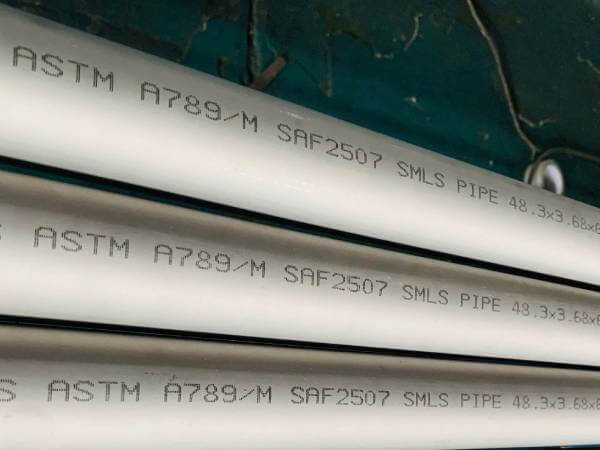
Duplex stainless steel is finding increased applications as structural material in critical components of nuclear power plants, chemical industries, oil and gas sectors, paper and pulp industries, transportation and other general engineering applications because of higher strength, superior resistance to stress corrosion cracking and better weldability. The excellent combination of mechanical properties and corrosion resistance of duplex stainless steel is obtained from balanced amount of ferrite and austenite in the microstructure. Duplex stainless steels are magnetic and have roughly twice the yield strength of austenitic stainless steels. In addition, their mixed microstructure provides better pitting corrosion resistance and chloride stress corrosion resistance than austenitic stainless steels types 304 and 316. However, this grade of steel embrittles when exposed in the temperature range of 280–500 °C limiting its application to temperatures below 280 °C. This phenomenon is termed 475 °C embrittlement as the rate of embrittlement is highest at 475 °C. The embrittlement changes the tensile, fracture and fatigue behaviour of this steel.
Duplex Stainless Steel Composition
| UNS Desig. | Type | C | Mn | P | S | Si | Cr | Ni | Mo | N | Cu | Other Elements |
|---|---|---|---|---|---|---|---|---|---|---|---|---|
| S31200 | . . . | 0.030 | 2.00 | 0.045 | 0.030 | 1.00 | 24.0–26.0 | 5.5–6.5 | 1.20–2.00 | 0.14–0.20 | . . . | . . . |
| S31260 | . . . | 0.03 | 1.00 | 0.030 | 0.030 | 0.75 | 24.0–26.0 | 5.5–7.5 | 2.5–3.5 | 0.10–0.30 | 0.20–0.80 | W 0.10–0.50 |
| S31803 | . . . | 0.030 | 2.00 | 0.030 | 0.020 | 1.00 | 21.0–23.0 | 4.5–6.5 | 2.5–3.5 | 0.08–0.20 | . . . | . . . |
| S32001 | . . . | 0.030 | 4.00–6.00 | 0.040 | 0.030 | 1.00 | 19.5–21.5 | 1.00–3.00 | 0.60 | 0.05–0.17 | 1.00 | . . . |
| S32003 | . . . | 0.030 | 2.00 | 0.030 | 0.020 | 1.00 | 19.5–22.5 | 3.0–4.0 | 1.50–2.00 | 0.14–0.20 | . . . | . . . |
| S32101 | 2101 | 0.040 | 4.00–6.00 | 0.040 | 0.030 | 1.00 | 21.0–22.0 | 1.35–1.70 | 0.10–0.80 | 0.20–0.25 | 0.10–0.80 | . . . |
| S32202 | 2202 | 0.030 | 2.00 | 0.040 | 0.010 | 1.00 | 21.5–24.0 | 1.00–2.80 | 0.45 | 0.18–0.26 | . . . | . . . |
| S32205 | 2205 | 0.030 | 2.00 | 0.030 | 0.020 | 1.00 | 22.0–23.0 | 4.5–6.5 | 3.0–3.5 | 0.14–0.20 | . . . | . . . |
| S32304 | 2304 | 0.030 | 2.50 | 0.040 | 0.030 | 1.00 | 21.5–24.5 | 3.0–5.5 | 0.05–0.60 | 0.05–0.20 | 0.05–0.60 | . . . |
| S32506 | . . . | 0.030 | 1.00 | 0.040 | 0.015 | 0.90 | 24.0–26.0 | 5.5–7.2 | 3.0–3.5 | 0.08–0.20 | . . . | W 0.05–0.30 |
| S32520 | . . . | 0.030 | 1.50 | 0.035 | 0.020 | 0.80 | 24.0–26.0 | 5.5–8.0 | 3.0–4.0 | 0.20–0.35 | 0.50–2.00 | . . . |
| S32550 | 255 | 0.04 | 1.50 | 0.040 | 0.030 | 1.00 | 24.0–27.0 | 4.5–6.5 | 2.9–3.9 | 0.10–0.25 | 1.50–2.50 | . . . |
| S32750 | 2507 | 0.030 | 1.20 | 0.035 | 0.020 | 0.80 | 24.0–26.0 | 6.0–8.0 | 3.0–5.0 | 0.24–0.32 | 0.50 | . . . |
| S32760 | . . . | 0.030 | 1.00 | 0.030 | 0.010 | 1.00 | 24.0–26.0 | 6.0–8.0 | 3.0–4.0 | 0.20–0.30 | 0.50–1.00 | W 0.50–1.00 |
| S32808 | . . . | 0.030 | 1.10 | 0.030 | 0.010 | 0.50 | 27.0–27.9 | 7.0–8.2 | 0.80–1.2 | 0.30–0.40 | . . . | W 2.10–2.50 |
| S32900 | 329 | 0.08 | 1.00 | 0.040 | 0.030 | 0.75 | 23.0–28.0 | 2.0–5.00 | 1.00–2.00 | . . . | . . . | . . . |
| S32906 | . . . | 0.030 | 0.80–1.50 | 0.030 | 0.030 | 0.80 | 28.0–30.0 | 5.8–7.5 | 1.50–2.60 | 0.30–0.40 | 0.80 | . . . |
| S32950 | . . . | 0.030 | 2.00 | 0.035 | 0.010 | 0.60 | 26.0–29.0 | 3.5–5.2 | 1.00–2.50 | 0.15–0.35 | . . . | . . . |
| S39274 | . . . | 0.030 | 1.00 | 0.030 | 0.020 | 0.80 | 24.0–26.0 | 6.0–8.0 | 2.5–3.5 | 0.24–0.32 | 0.20–0.80 | W 1.50–2.50 |
| S81921 | . . . | 0.030 | 2.00–4.00 | 0.040 | 0.030 | 1.00 | 19.0–22.0 | 2.0–4.0 | 1.00–2.00 | 0.14–0.20 | . . . | . . . |
| S82011 | . . . | 0.030 | 2.00–3.00 | 0.040 | 0.020 | 1.00 | 20.5–23.5 | 1.0–2.0 | 0.10–1.00 | 0.15–0.27 | 0.50 | . . . |
| S82012 | . . . | 0.05 | 2.00–4.00 | 0.040 | 0.005 | 0.80 | 19.0–20.5 | 0.8–1.5 | 0.10–0.60 | 0.16–0.26 | 1.00 | . . . |
| S82013 | . . . | 0.060 | 2.50–3.50 | 0.040 | 0.030 | 0.90 | 19.5–22.0 | 0.5–1.5 | . . . | 0.20–0.30 | 0.20–1.20 | . . . |
| S82031 | . . . | 0.05 | 2.50 | 0.040 | 0.005 | 0.80 | 19.0–22.0 | 2.0–4.0 | 0.60–1.40 | 0.14–0.24 | 1.00 | . . . |
| S82121 | . . . | 0.035 | 1.00–2.50 | 0.040 | 0.010 | 1.00 | 21.0–23.0 | 2.0–4.0 | 0.30–1.30 | 0.15–0.25 | 0.20–1.20 | . . . |
| S82122 | . . . | 0.030 | 2.0–4.0 | 0.040 | 0.020 | 0.75 | 20.5–21.5 | 1.5–2.5 | 0.60 | 0.15–0.20 | 0.50–1.50 | . . . |
| S82441 | . . . | 0.030 | 2.50–4.00 | 0.035 | 0.005 | 0.70 | 23.0–25.0 | 3.0–4.5 | 1.00–2.00 | 0.20–0.30 | 0.10–0.80 | . . . |
Chenmical conposition, %, Maximum, unless range or minimum is indicated. Where ellipses (. . .) appear in this table, there is no requirement and the element need not be determined or reported
Duplex Stainless Steel Characteristics
- High Strength: With a yield strength of up to 400–550 MPa—more than twice that of standard austenitic stainless steels (such as 304 and 316)—it allows for a 30%–50% reduction in wall thickness, thereby lowering material and manufacturing costs.
- Excellent resistance to chloride stress corrosion cracking (SCC): In chloride-containing environments (such as seawater and chemical media), its resistance to SCC is significantly superior to that of 300-series austenitic stainless steels, which are prone to stress corrosion cracking in neutral chloride solutions above 60°C.
- Good resistance to localized corrosion: Duplex stainless steels containing molybdenum and nitrogen (such as 2205 and 2507) exhibit excellent resistance to pitting and crevice corrosion, with PREN values (pitting resistance equivalent number) reaching 32–45+, and some grades even outperforming 6% Mo austenitic stainless steels.
- Nickel-saving design, high cost-effectiveness: With lower nickel content (3%–10%), they offer a cost advantage over high-nickel austenitic stainless steels while maintaining good corrosion resistance
- Excellent weldability: Low susceptibility to hot cracking; generally no preheating is required before welding, and no post-weld heat treatment is needed; suitable for dissimilar welding with carbon steel or austenitic stainless steel
- Good toughness and ductility: Elongation in the solution-annealed condition ≥25%, V-notch impact energy (AK) >100 J; maintains good toughness even at low temperatures of -40°C
- High thermal conductivity and low coefficient of thermal expansion: Thermal conductivity exceeds that of austenitic stainless steel, while the coefficient of thermal expansion is similar to that of carbon steel. Suitable for manufacturing composite plates, linings, or heat exchanger tube cores, enhancing heat transfer efficiency and facilitating dissimilar steel connections
- Resistance to corrosion fatigue and wear corrosion: Suitable for power equipment operating under dynamic conditions, such as pumps and valves
Duplex Stainless Steel Types
Lean duplex stainless steels: The lean duplex grades such as LDX 2101® (S32101), UR 2202 (S32202), ATI 2102® (S82011) and 2304 (S32304) are characterized by relatively low levels of nickel and/or molybdenum. To compensate for the reduced nickel content, which is a strong austenite former, these grades have increased levels of nitrogen and manganese, which provide an acceptable austenite/ferrite phase balance. As a group the lean grades have high strength, particularly yield strength, and exhibit a pitting and crevice corrosion resistance that is similar to, or just below that, of the Type 316L austenitic grade. Because of their relatively high yield strength, the lean DSSs are well suited for tank construction and structural applications.
Standard duplex stainless steels: The standard duplex grades typically contain 21-25% chromium, 2-3% molybdenum and 0.15% nitrogen. Grades in this category are used widely across all industry sectors and 2205 (S32205) has become by far the most widely used duplex grade. The 2205 grade has a yield strength that is more than twice that of Type 316 and a pitting and crevice corrosion resistance that is similar to Type 904L austenitic stainless steel. Applications for standard duplex grades include tanks, piping, process vessels and structural applications.
Super duplex stainless steels: The super duplex stainless steels typically contain 25% chromium, 3.5-4.0% molybdenum, and 0.25-0.27% nitrogen. The pitting and crevice corrosion resistance of the super duplex grades are essentially equivalent to the 6% Mo super austenitic stainless steels. The most widely used super duplex stainless steel grades are the 2507 (S32750) and Z100 (S32760) grades. Common applications include piping, heat exchangers, tanks, and process vessels used for chemical processing and marine applications.
Hyper duplex stainless steels: The hyper duplex stainless steels, S33207 and SAF S32707 are the most highly alloyed of the duplex family and contain 26-30% chromium, 3.5-5.0% molybdenum, and 0.30-0.50% nitrogen. The hyper duplex grades are designed for more aggressive acid and chloride-containing environments. They are produced in limited quantities and are currently only available as seamless tubing.
Duplex Stainless Steel Microstructure
Duplex stainless steels are characterised by a two phase structure, which consists of a mixture of about 50 % volume FCC austenite islands in BCCferrite grains. Both cast and wrought products have roughly equivalent volume fractions of ferrite and austenite, which, in the case of wrought components, contain a rolling texture obtained by hot working, followed by a solution annealing and quench. The optimum phase balance for modern wrought products varies between manufacturers, but overall a range of between 45% and 60% austenite may be expected. The structure is obtained by simultaneous control of the chemical composition and annealing temperature.
Physical Properties of Duplex Stainless Steels Compared with Carbon Steel and Austenitic Stainless Steels.
| Grade | UNS No. | Density | Specific heat | Electrical resistivity | Young’s modulus | ||||
|---|---|---|---|---|---|---|---|---|---|
| g/cm 3 | lb./in 3 | J/kg K | Btu/lb./°F | micro W m | micro W in. | GPa | x10 6 psi | ||
| Carbon steel | G10200 | 7.64 | 0.278 | 447 | 0.107 | 0.10 | 3.9 | 207 | 30.0 |
| 304 | S30400 | 7.98 | 0.290 | 502 | 0.120 | 0.73 | 28.7 | 193 | 28.0 |
| 316 | S31600 | 7.98 | 0.290 | 502 | 0.120 | 0.75 | 29.5 | 193 | 28.0 |
| 329 | S32900 | 7.75 | 0.280 | 460 | 0.110 | 0.80 | 31.5 | 200 | 29.0 |
| S32101 | 7.80 | 0.281 | 500 | 0.119 | 0.80 | 31.5 | 200 | 29.0 | |
| 2304 | S32304 | 7.75 | 0.280 | 482 | 0.115 | 0.80 | 31.5 | 200 | 29.0 |
| S31803 | 7.80 | 0.281 | 500 | 0.119 | 0.80 | 31.5 | 200 | 29.0 | |
| 2205 | S32205 | 7.80 | 0.281 | 500 | 0.119 | 0.80 | 31.5 | 200 | 29.0 |
| S31260 | 7.80 | 0.281 | 502 | 0.120 | 200 | 29.0 | |||
| 255 | S32550 | 7.82 | 0.282 | 488 | 0.116 | 0.84 | 33.1 | 210 | 30.5 |
| S39274 | 7.80 | 0.281 | 502 | 0.120 | 200 | 29.0 | |||
| S32520 | 7.75 | 0.280 | 450 | 0.108 | 0.85 | 33.5 | 205 | 29.7 | |
| 2507 | S32750 | 7.75 | 0.280 | 485 | 0.115 | 0.80 | 31.5 | 200 | 29.0 |
| S32760 | 7.80 | 0.281 | 0.85 | 33.5 | 190 | 27.6 | |||
| S32707 | 7.80 | 0.281 | 470 | 0.112 | 0.75 | 29.5 | 197 | 28.5 | |
Duplex Stainless Steel Corrosion Resistance
Duplex stainless steels exhibit a high level of corrosion resistance in most environments where the standard austenitic grades are used. However, there are some notable exceptions where they are decidedly superior. This results from their high chromium content, which is beneficial in oxidizing acids, along with sufficient molybdenum and nickel to provide resistance in mildly reducing acid environments. The relatively high chromium, molybdenum and nitrogen also give them very good resistance to chloride-induced pitting and crevice corrosion. The duplex structure is an advantage in potential chloride stress corrosion cracking environments. If the microstructure contains at least thirty percent ferrite, duplex stainless steels are far more resistant to chloride stress corrosion cracking than austenitic stainless steel Types 304 or 316. Ferrite is, however, susceptible to hydrogen embrittlement. Thus, the duplex stainless steels do not have high resistance in environments or applications where hydrogen may be charged into the metal and cause hydrogen embrittlement.
Duplex Stainless Steel Specifications
- A.182/A182M: ‘Forged or rolled alloy-steel pipe flanges, forged fittings, and valves and parts for high-temperature service
- A240/A240M: Heat-resisting chromium and chromium-nickel stainless steel plate, sheet and strip for pressure vessels
- A268/ A268M: Seamless and welded ferritic and martensitic stainless steel tubing for general service
- A276: Stainless steel bars and shapes
- A297 / A297M: Steel castings, iron-chromium and iron-chromium-nickel, heat resistant, for general application
- A314: Stainless steel billets and bars for forging
- A351/A351: Castings, austenitic, austenitic-ferritic (duplex),for pressure-containing parts
- A473: Stainless steel forgings
- A479/ A479M: Stainless steel bars and shapes for use in boilers and other pressure vessels
- A743/A743M: Castings, iron-chromium and iron-chromium-nickel, corrosion-resistant, for general application
- A744/ A744M: Castings, iron-chromium-nickel, corrosion-resistant, for severe service
- A789/ A789M: Seamless and welded ferritic/austenitic stainless steel tubing for general service
- A790/ A790M: Seamless and welded ferritic/austenitic stainless steel pipe
- A815/A815M: Wrought ferritic, ferritic/austenitic, and martensitic stainless steel piping fittings
- A872: Centrifugally cast ferritic/austenitic stainless steel pipe for corrosive environments
- A890/ A890M: Castings, iron-chromium-nickel-molybdenum corrosion resistant, duplex (austenitic/ferritic) for general application
- A928/A928M: Ferritic/austenitic (duplex) stainless steel pipe electric fusion welded with addition of filler metal’, ASTM, 1996
- A949/949M: Spray-formed seamless ferritic/austenitic stainless steel pipe
- EN 10028-7: Flat products made of steel for pressure vessel purposes. Part 7: Stainless steels
- EN 10088-1: Stainless steels – Part 1: List of stainless steels
- EN 10088-2: Stainless steels – Part 2: Technical delivery conditions for sheet/plate and strip for general purposes
- EN 10088-3: Stainless steels – Part 3: Technical delivery conditions for semi-finished products, bars, rods and sections for general purposes
- EN 10250-5: Open die steel forgings for general engineering purposes – Part 5: Stainless steels
- EN 10272: Stainless steel bars for pressure purposes
- MR0175: Sulfide stress corrosion cracking resistant materials for oilfield equipment
Duplex Stainless Steel Applications
- Chemical and petrochemical
- Oil and gas
- Pulp and paper
- Power generation
- Marine transportation
- Other applications